4. RayTracing
For checking the curvature of mirrors, use a circle with center at twice the focal length.
For lenses, use a circle at the focal length for a close approximation.
4.1. Lensmaker’s Equation
The focal length ( f ) of a thin lens in air is given by:
\[\frac{1}{f} = (n - 1) \left( \frac{1}{R_1} - \frac{1}{R_2} \right)\]
Where:
( f ) is the focal length of the lens
( n ) is the refractive index of the lens material
( R_1 ) is the radius of curvature of the first lens surface
( R_2 ) is the radius of curvature of the second lens surface
For a symmetric lens where ( R_1 = -R_2 = R ), the equation simplifies to:
\[\frac{1}{f} = \frac{2(n - 1)}{R}\]
Solving for ( R ):
\[R = 2(n - 1)f\]
For acrylic, n = 1.49.
So R = 0.98 f
Hence, a circle of radius, f, at f, will be clos enough to manually observe curvature.
4.1.1. Optical axes
A simple cross shape on the landscape page is useful for ray diagrams.

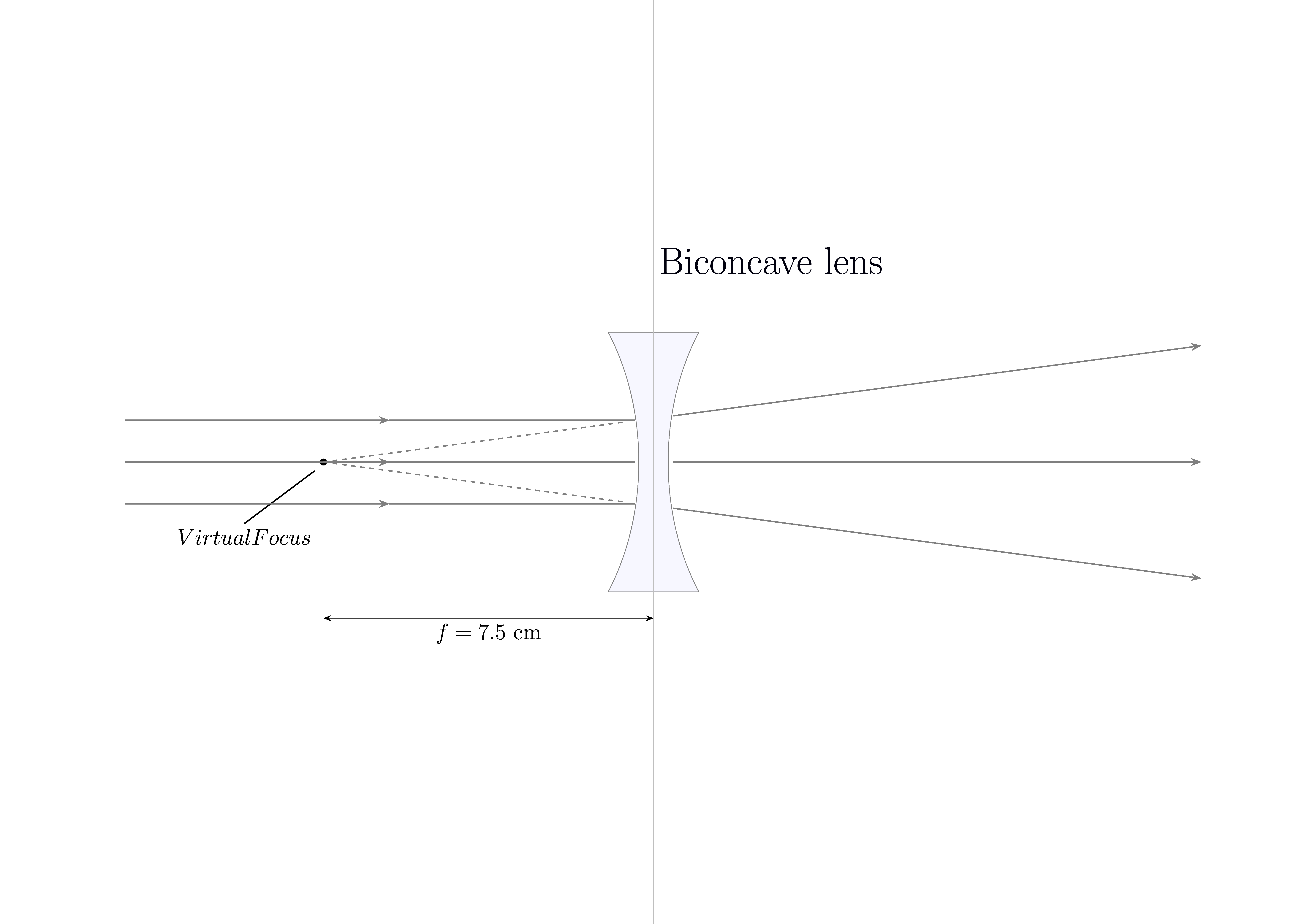
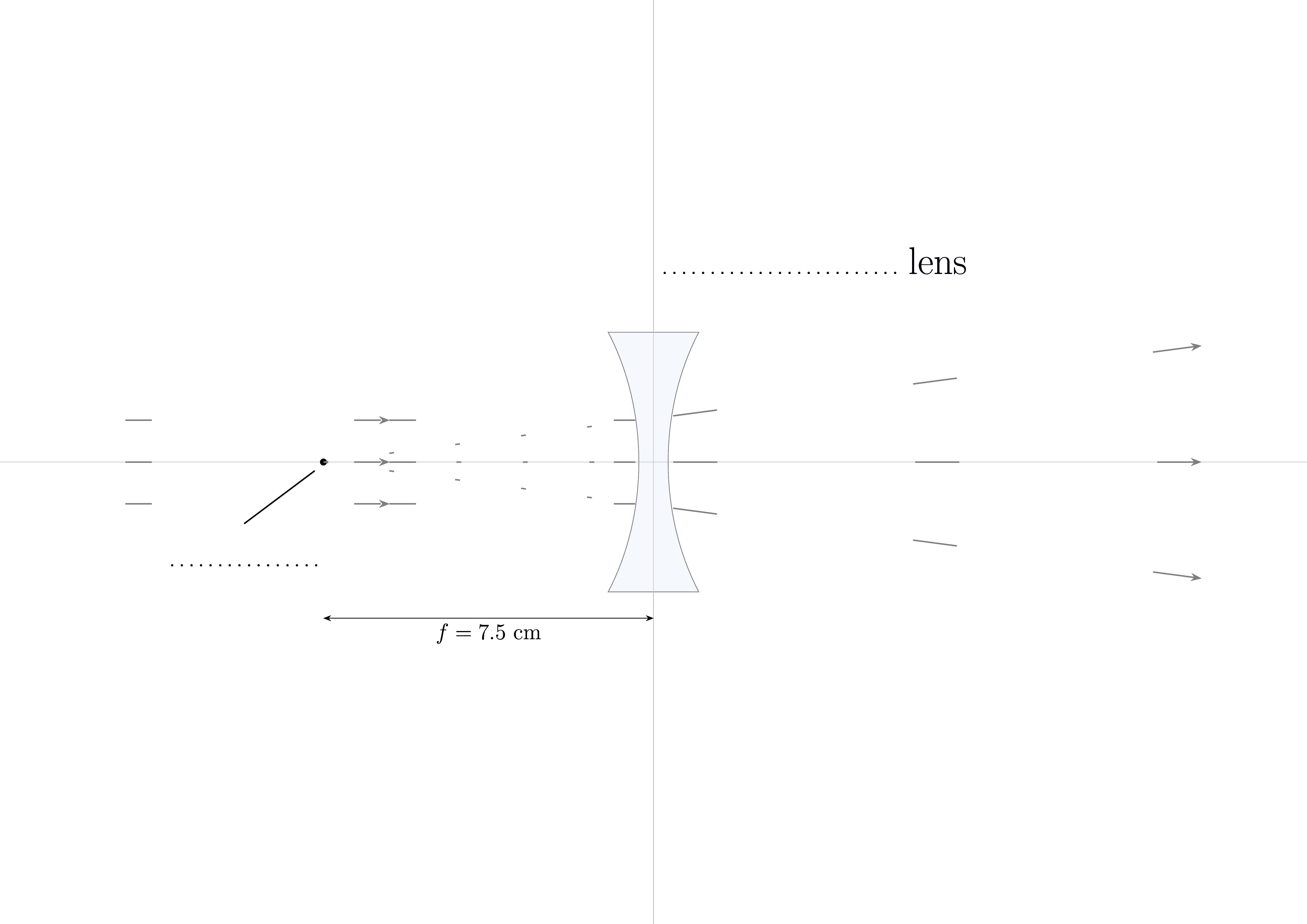
4.1.2. Biconcave lens
Student version and full versions are shown below.
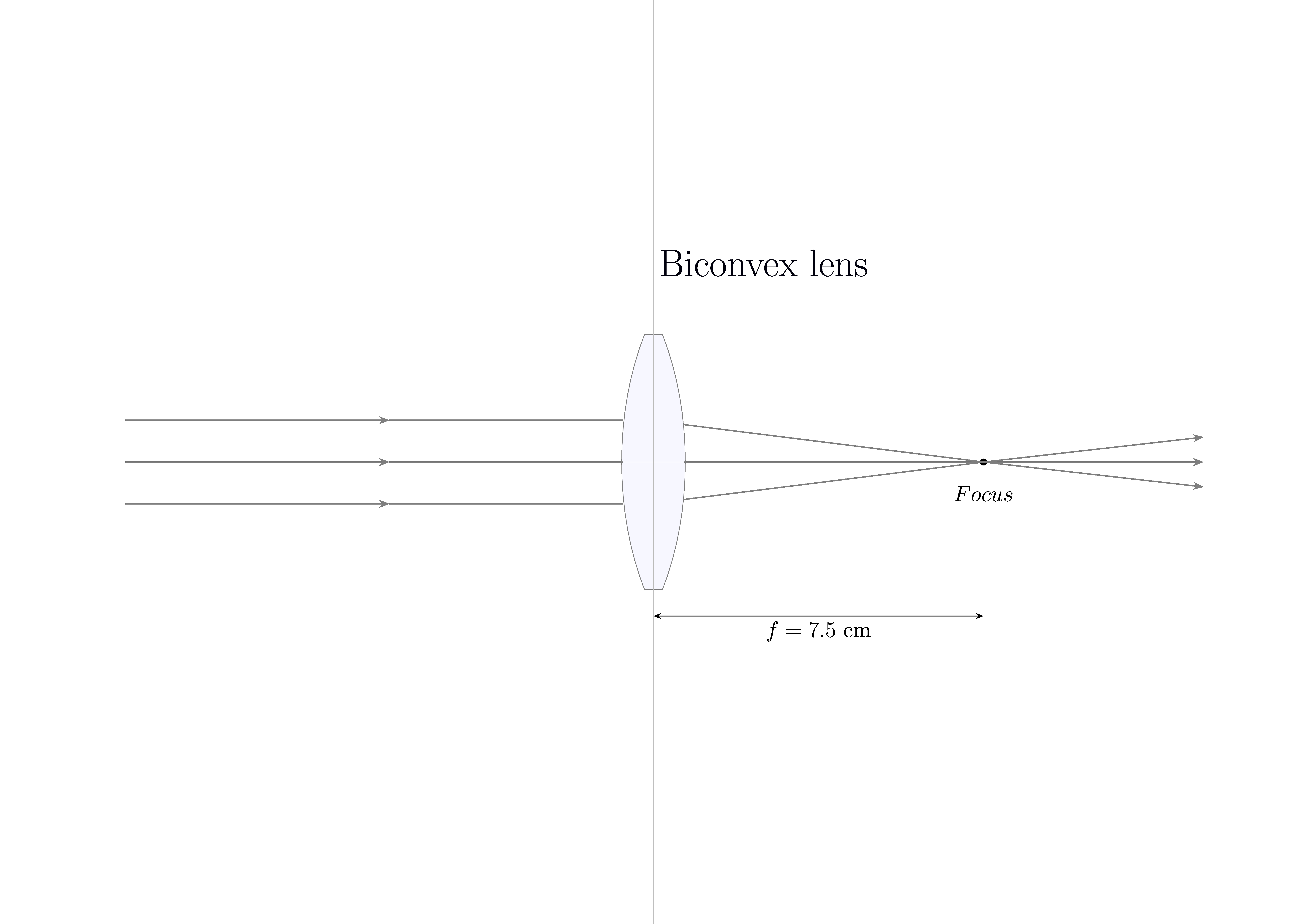
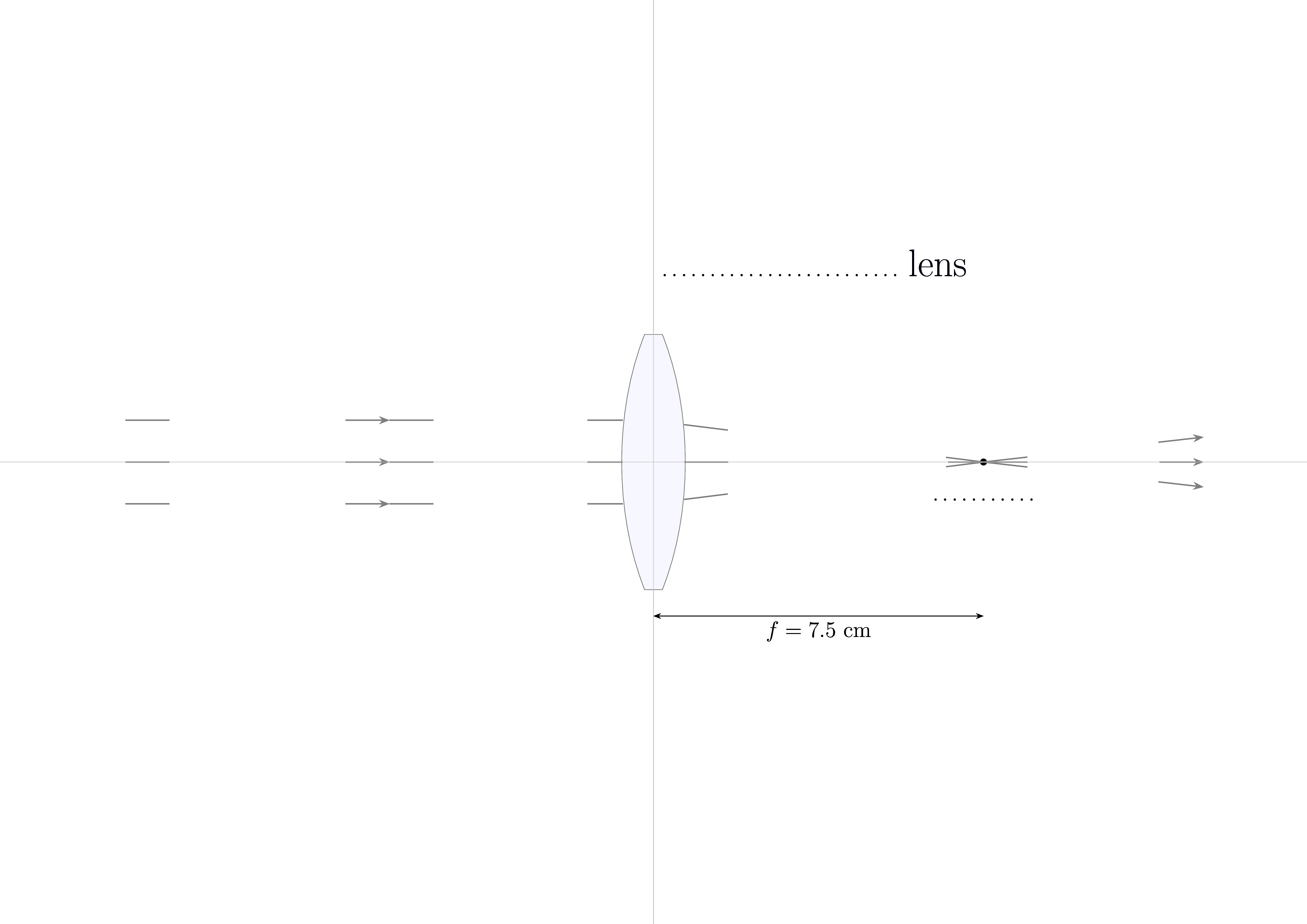
4.1.3. Biconvex lens
Student version and full versions are shown below.
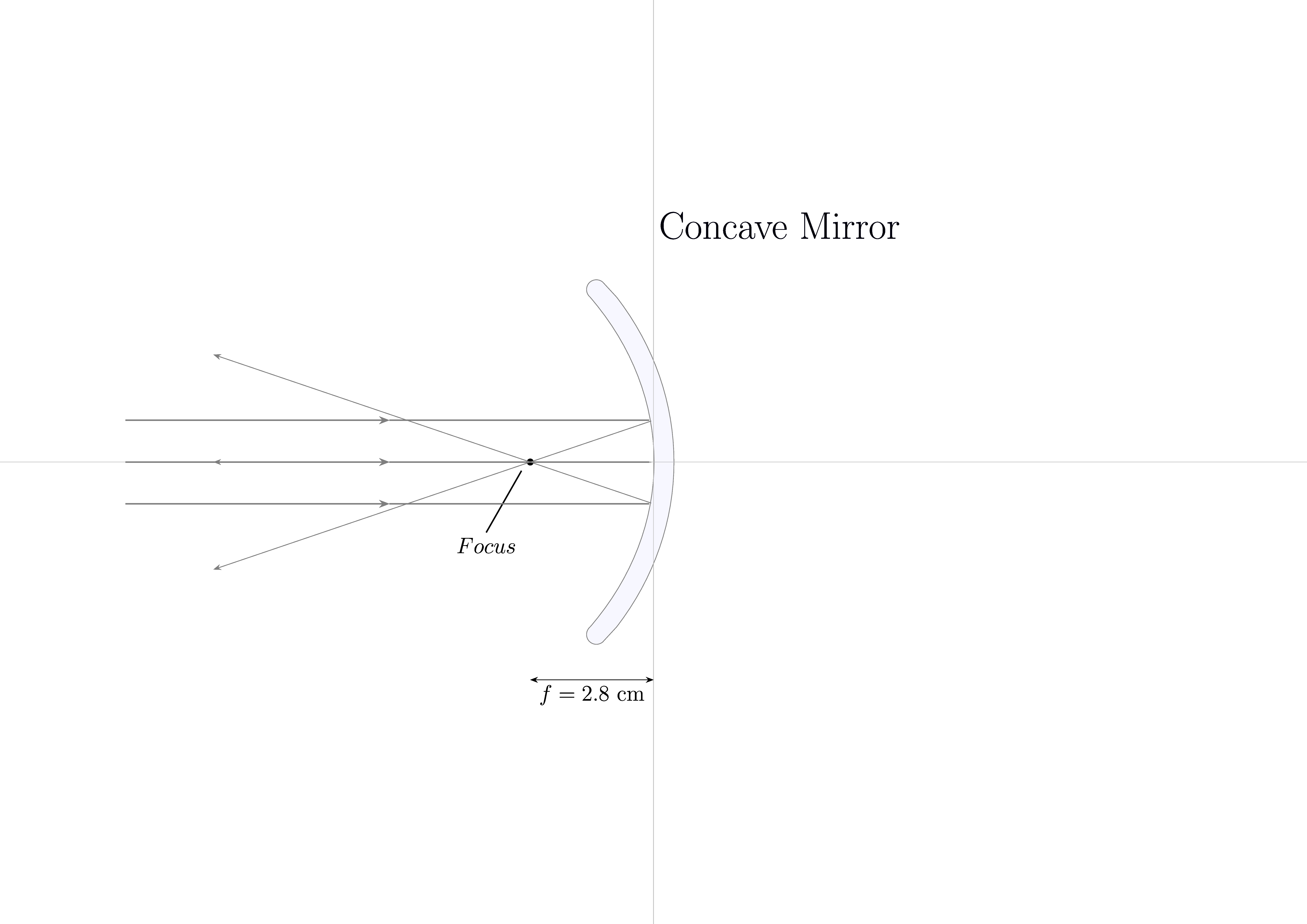
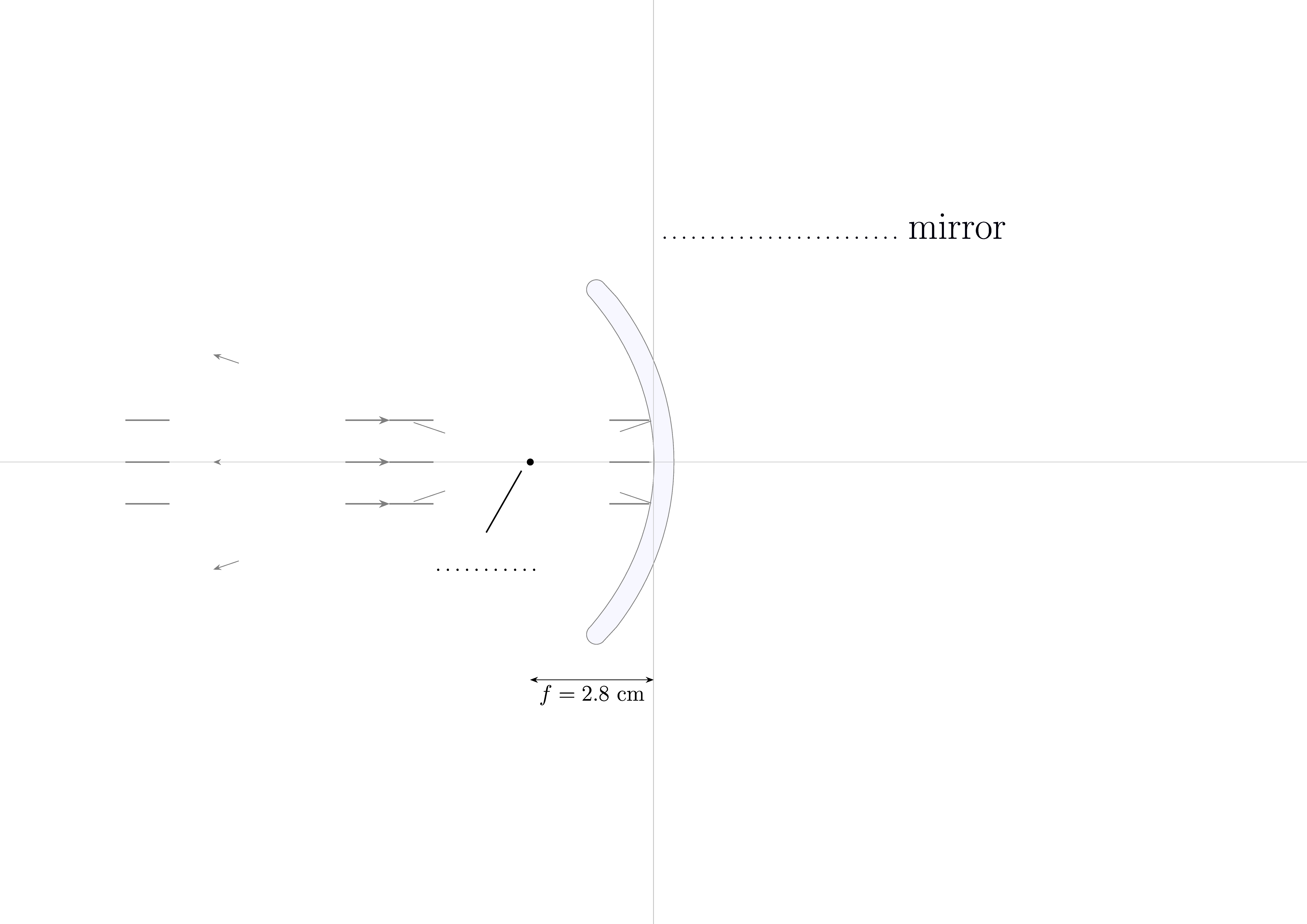
4.1.4. Concave mirror
Student version and full versions are shown below.
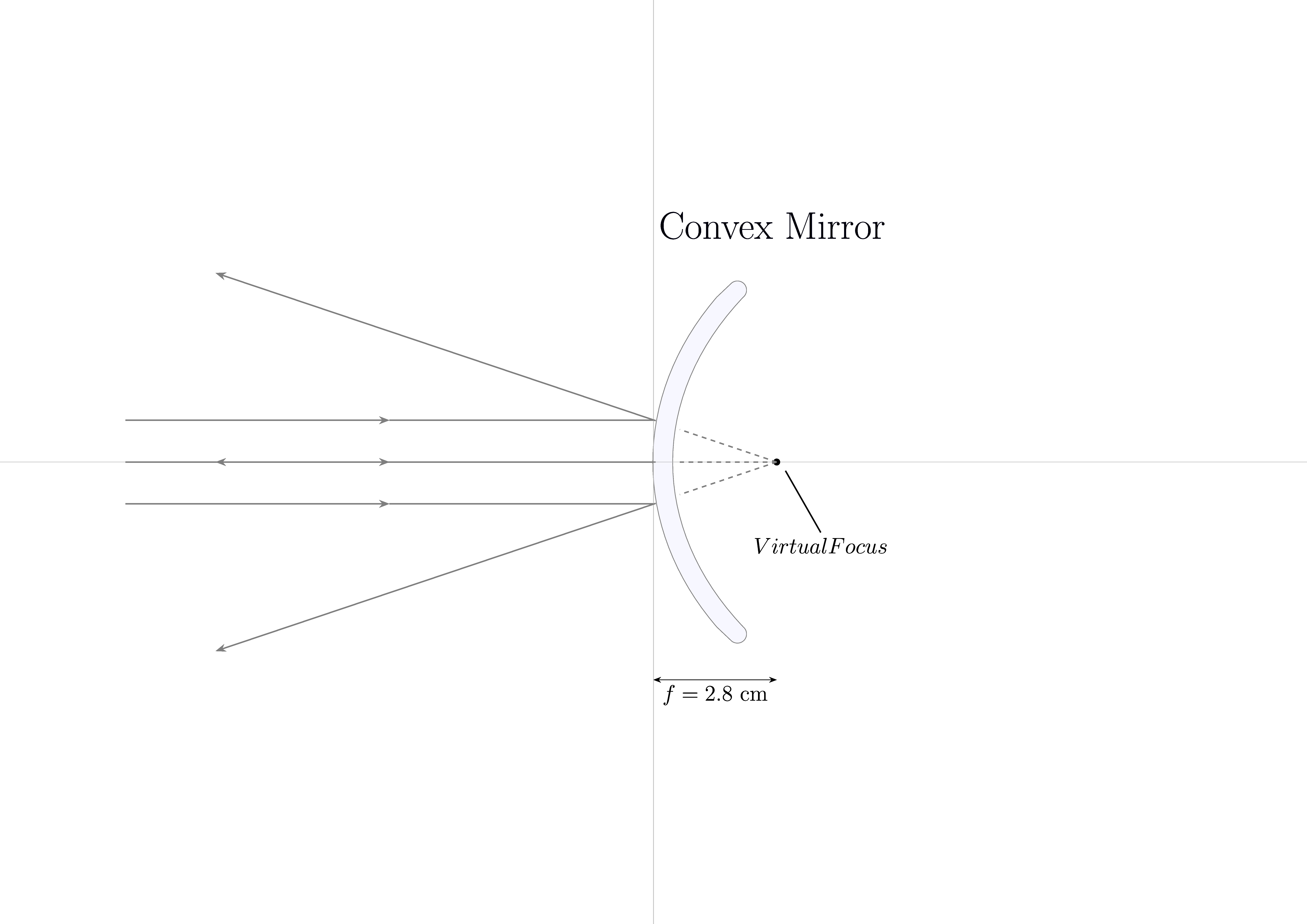
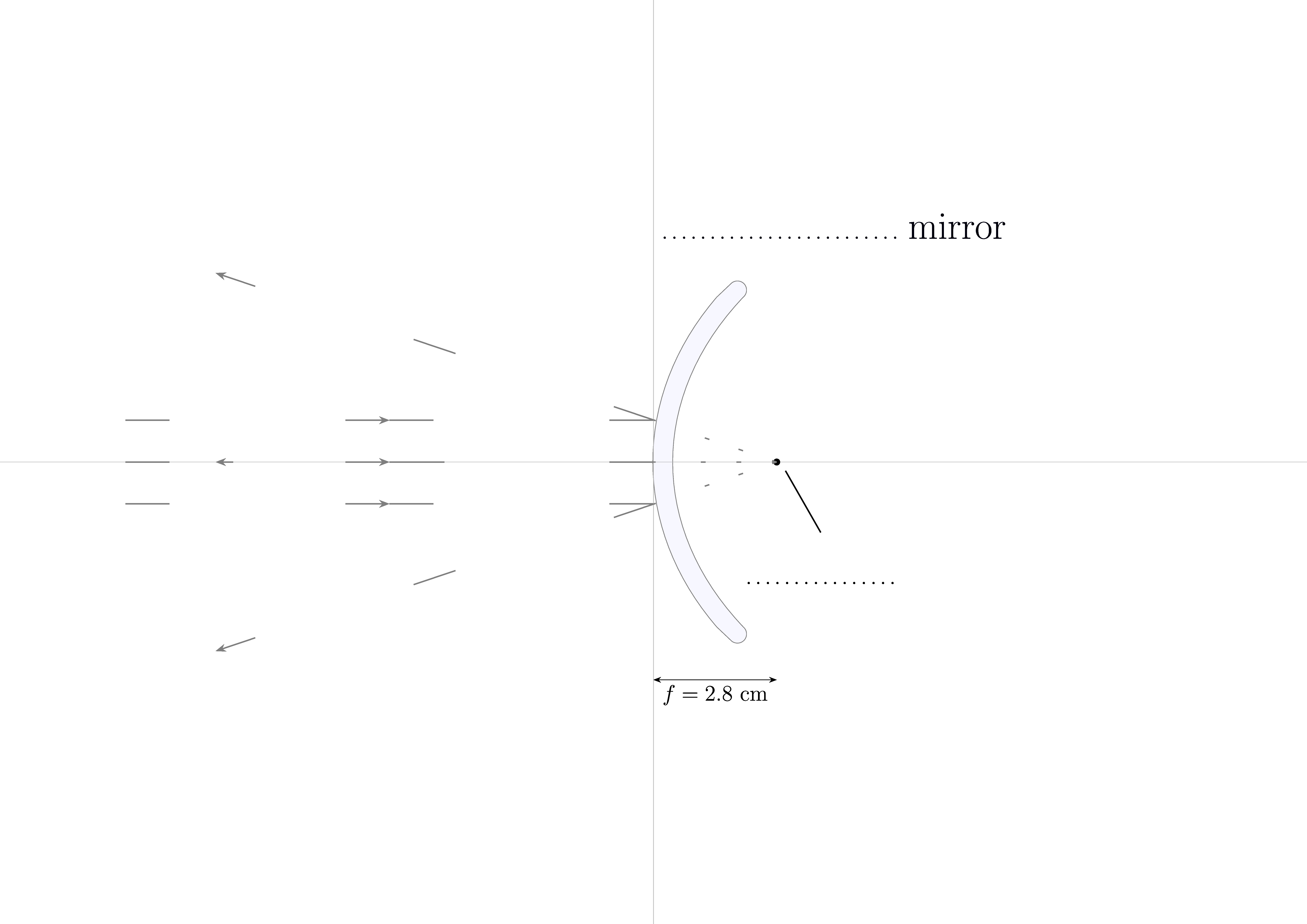
4.1.5. Convex mirror
Student version and full versions are shown below.
4.1.6. Refraction in a block
Student version and full versions are shown below.

Downloads
refraction_80.pdfrefraction_80.tex
Downloads
refraction_80_student.pdfrefraction_80_student.tex
Downloads
refraction_60.pdfrefraction_60.tex
Downloads
refraction_60_student.pdfrefraction_60_student.tex
Downloads
refraction_30.pdfrefraction_30.tex
Downloads
refraction_30_student.pdfrefraction_30_student.tex